Showing posts with label caterpillar rearing. Show all posts

Saturday, July 25, 2015

A Quick rundown on the season so far

Well what a whirlwind of a summer! After waiting through 5 tense weeks of rain, finally it has stopped. I just hope it picks up a little. Now the garden at home is too dry. Got through the rain wondering, where are all monarchs? I guess they were waiting to lay their eggs. Now it is eggapalooza!
The season started slow with only finding a few eggs to collecting 30-60 daily at work and home. I have to thank my seasonal works who are getting into the conservation thing and actively looking for eggs for me. We have milkweed at almost every park and facility where I work and so that makes collecting easy. I did this by design but also from an educational standpoint. Our facilities (park district) have kids and moms and dads going in and out all day, not to mention day camps! I want those kids visiting to say, I saw a monarch butterfly lay her eggs today at camp! We have a wonderful Naturalist that works with us and she does the bulk of the education. So anywhere I can help that out, make it more convenient.... I grow all the mw we use in the parks in our greenhouse so it is all pesticide free.
Oh and the nice garden club lady who dropped off a caterpillar, thank you. It will be well cared for by little Gwennie.
At home where I  raise these eggs into butterflies, is a little chaotic right now. We are in the tail end of a renovation project and I have no tables in the house. I can't wait to get my dining room up! I need a project space. The hatching boxes where the eggs go are literally on the kitchen floor.
When I bring eggs home, I  "process" them. By this I mean that I get a clean hatching box. I clean with bleach and make sure to rinse and dry well. I then place a paper towel in the bottom of the box and spray it with a little spray bottle. Make the paper towel a little damp.  The reason for this is too keep the eggs alive until the eggs hatch. After I get them all into the boxes, I count them,  make sure any funny looking ones get closer inspection with a jeweler's loupe.
http://www.amazon.com/dp/B00533VJSG/ref=wl_it_dp_o_pd_nS_ttl?_encoding=UTF8&colid=GRI0HJNXLA91&coliid=I143UQMWVJG2EK

Any bad eggs go out. I make sure there are no aphids or anything nasty on the leaves. Then I seal the box. This is important. Seal the box, make a hydration chamber so leaves live. I also open and close those boxes at least once a day to get fresh air in. You will want to see if they are hatching anyway.  And then you wait. When they start hatching, after 2-4 days,  I start putting new food in. Wash the leaves off and pat dry. I don't always transfer every tiny cat. to a new leaf. That would be too time consuming for the numbers I am taking care of. However when I had less than 100 I would definitely transfer them. I use the tip of a toothpick. Some use a paint brush.
Feed the cats and clean the boxes daily. Period. If you do not want a bacterial outbreak and cats dying, cleanliness is the most important aspect of this activity.
For my operation, when the cats get about an inch or so in length I think about taking them out to the caterpillar house. This is a structure built by my husband, Lee. It took him about 20 hours to build and believe it not, he used no plans. We deconstructed the old cat. house and there was enough wood there to reuse into the new one. He only had to buy a little bit of wood.
While out in the cat. house the cats are fed from large cuttings of common and tropical mw. They are in vases that are weighed down with marbles and the opening of the vase is covered with plastic wrap to keep cats. from falling in and drowning.
Then they just do their thing. Eat until it is time them make their chrysalids. They wander around the cat. house for a while and settle in a spot. When they eclose, I release them the same day.
So why do I do this, all of this? I definitely have enough to do over the summer. I work full time, lecture at garden clubs, but only a few in the summer. I have a large garden to take care of and other responsibilities.
I don't want to get all sanctimonious about this and say that I am going to save this species. I have genuine sympathy for the monarch and their plight. I do this because the symbolism of the metamorphosis is important for me. I think that this species is a good ambassador for all the insect world and why we should protect them. Except aphids. I don't like aphids. Oh and mosquitoes...oh well. Most insects are really cool and beautiful. And I do it because it is fun.  Although this week it is feeling like a job. :)
Next up I will address those insects that also use mw for their home.


The hatching boxes, only 20-25 in each
Out in the Garden
The "Nursery"

The large Monarch Waystation at work, cared for by devoted volunteers!
The first batch of cats. in the house
The first batch in the house

Sunday, August 22, 2010

This is what I call a Family Tree!


newly hatched monarchsegg and caterplillar storage

A monarch resting before being released, this can take a few hours. And the new improved caterpillar storage system


What a family tree!


Everyone munching on the same branch!


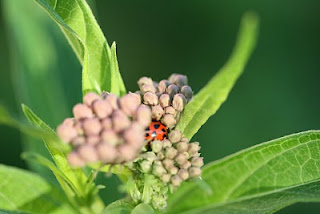
ladybug laying in wait ladybug eating aphids on milkweed

A lady bug doing it's job eating aphids!

*I just want to say thanks for all the sweet email & fb messages about the butterflies. I truly enjoy this, however my slightly obsesive personality has gotten a hold. If I go out to visit the caterpillar house I find that and hour or more has passed since I opened that door :). I am happy to share this with you and it makes me happy that you are all enjoying the experience too! *

Now back to regularly scheduled programing....

I was out this morning checking in with the cat. house. There were 9 butterflies yesterday and 11 today. The tally for released butterflies is 137 give or take a few, I don't have a completely accurate number for Friday the 20th. I guess I was in too much of a hurry ... But I digress. The egg laying has slowed down this week in my garden and I think it may have something to do with the yucky aphids. I blasted off all the critters with the garden hose. Not as easy as it sounds! I had to cup the tops of the plants in my hands and blasted them. now multiply that by 12 plants, some with multiple branches. I got a couple of funny looks from the nieghbor- whatever man! It did not take very long. Consequently my arm was covered in creepy crawlies- shudder- So the egg laying has stalled at 520 and the butterflies should be turning around and starting the journey to Mexico very soon. The egg laying doesn't surprise me. I did say that I would just collect until I couldn't find any more eggs, so we'll see what this week brings.


I have found that this little project for the summer takes some time to attend to. Caterpillars eat- a lot- and with eating comes the pooping...They poop a lot! As they get larger so does the poop. Sometimes I can't even see a caterpillar when they hatch from their egg, except for the little hole they eat in the leaf and the tiny dust-like poop. As they grow- so does the poop! If you don't clean the boxes you keep the cats. in before they go into the cat. house, the poop can contamiate everything and the little guys begin to die. I lost 3 cats. today because I was pretty distracted yesterday and thought everything was ok. When I opened the boxes today I found a lot of moldy leaves and I had to search for the very smallest cats. If you decide to jump into this for next summer just remember that you have germs and so do the cats. so wash your hands before nad after handling.


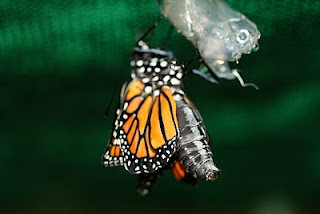
I watched 4 caterpillars pupate (make their chrysalis) this morning and I again missed 3 butterflies emerging. Darn! I keep missing it. That must go very quick. When the butterfly emerges its wings are wrinkled and its abdomen is very swollen. The fluid inside the abdomen is the gently pumped into the wings to expand them. The butterfly then chills out for the next few hours waiting for their wings to harden and they test them out flapping every few minutes until they are strong enough to fly.

monarch right after hatching

A monarch right after it emergered from its chrysalis, note the swollen abdomen.


They will feed soon after they beging flying. During the first part of summer and spring, the butterflies will mate and females lay about 500 eggs over a couple of weeks and then live a couple more weeks after that. I did mention earlier that the monarchs butterflies emerging at this time in the summer go into a period of diapause- they put off mating until next spring when they begin the journey north and then they will die. So this generation will live about 9-10 months.


Wednesday, August 11, 2010

The Latest Monarch News and Blues

monarch on sunflower @ Purdue


Well I can't believe this! I have released 86 Monarch butterflies up to today! The egg count as of tonight is 449! Unbelievable! I am also very surprised that about 80% have been collected in my own garden. I am really surprised at this since last summer I collected only 35 eggs and released about 22 monarchs. The only difference I can see is that I go out almost everyday and look at the milkweed plants.

In keeping track of the eggs collected and butterflies released, I am also keeping track of the little failures too.. I have had a few caterpillars die in the process of pupating (making their chrysalis) and three butterflies that have emerged with deformed wings. I think the caterpillars died because of our extreme heat this week. At least that is what I suspect. Unfortunately I have had euthanized the butterflies. In doing a little research, I found that the ones who emerge deformed are usueating flowersally carriers of a deadly fungal disease and/or a deadly bacterium. In any case, they cannot fly or feed so euthanizing is the most humane end for those individuals.


I find it very interesting that the caterpillars do not just eat all of the leaves in the milkweed stems I have giving them. I have observed them eating the seed pods and flowers too! So cool!
Have a great day! And don't forget to smile! smile!

Saturday, July 10, 2010

Caterpillar watch 2010

common milkweed
So this year I am taking in borders for the summer. Yep you heard me and I don't even have to cook for them! All I need to do is bring the little guys leaves every day.
This is my 4th year taking in monarch butterfly eggs. The reason why I do it is because I have seen insects eat the eggs before they hatch so if I take the eggs in the house instead of waiting for the eggs to hatch I would be much more successful at releasing adult monarch butterflies. Since they are a realtively threatened species, this helps keep their numbers up.
So where do you start? in late June, I begin checking the undersides of the three species of milkweed that I grow. They seem to favor common milkweed. A few days ago I sat in the car when I pulled up after work on a hot sunny afternoon and I observed a female monarch make her rounds through the garden laying eggs on the milkweed plants.
I bring the eggs in on the leaves and dig out my flat tupperware containers that my sis passed on to me. This way I can stack the boxes without taking a lot of room. I put 1 or 2 pieces of slightly dampened paper towel on the bottom of the box. Airtight boxes are best. The paper towel and the airtight nature of the tupperware keeps the leaves from drying up.
Once the eggs hatch they eat their egg casing first because it is rich in nutrients and they make a hole around it. that is how I know they have hatched and how multiple instars of monarchsI know I have missed many eggs out in the garden. Cleaning the boxes is necessary about every two days at this stage (their poops are really small) Keeping the boxes as clean as possible for their health is very important.
So far, as of today I have collected 47 eggs and found two caterpillars (pretty rare) and tonight I count 6 chrysalis' .